If you’ve searched for flower drawing for beginners, you’re probably holding your iPhone, staring at a blank sheet—and wondering: Can I really learn to draw realistic flowers without years of practice or expensive gear? Yes. In 2026, augmented reality has transformed how hobbyists and new artists build foundational skills—and it starts with something as simple as tracing a daisy, tulip, or rose petal using your phone’s camera.
This guide walks you through why flower drawing for beginners works so well with AR tracing, which floral subjects are easiest to start with, and exactly how to use the AR Drawing app for beginners to build confidence, hand-eye coordination, and observational accuracy—one petal at a time.
Why Flower Drawing for Beginners Is the Perfect First AR Tracing Project
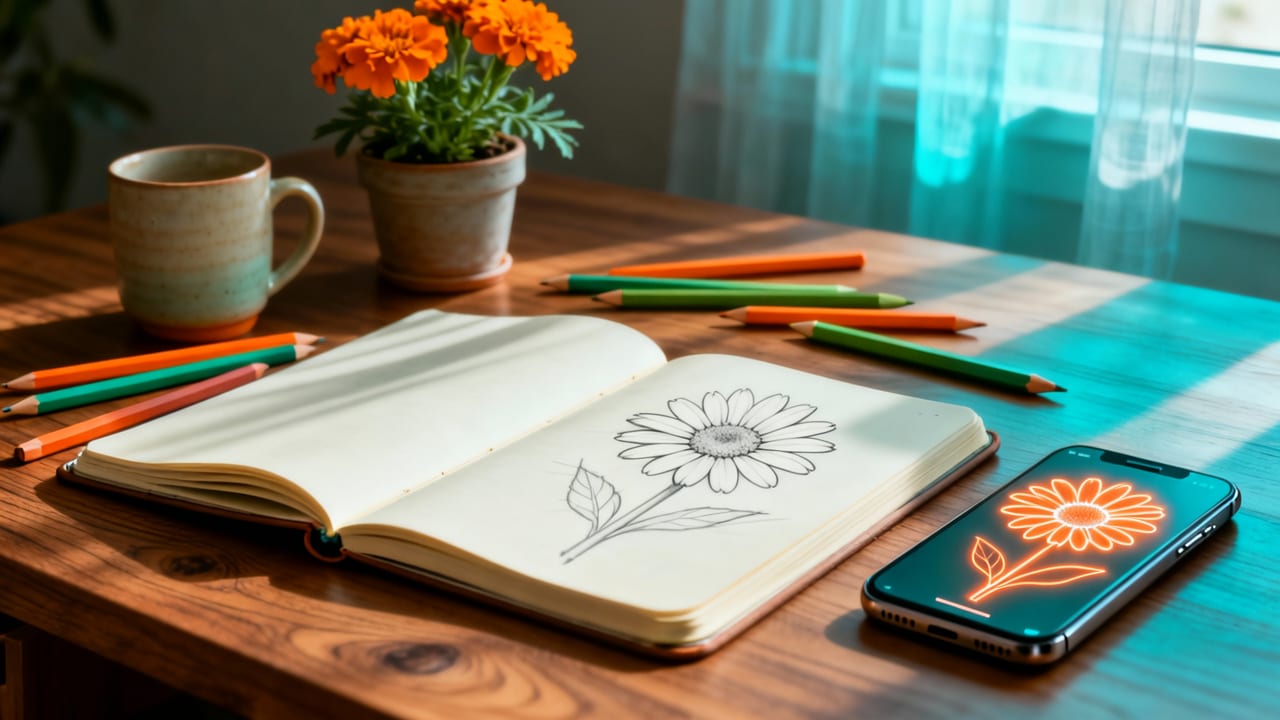
Flowers are ideal for early sketching practice—not because they’re “easy,” but because they offer structured repetition, gentle curves, and forgiving symmetry. Unlike complex portraits or perspective-heavy cityscapes, most flowers follow predictable patterns: radial petals, layered stamens, and organic but repeatable shapes. That makes them perfect for building muscle memory while minimizing frustration.
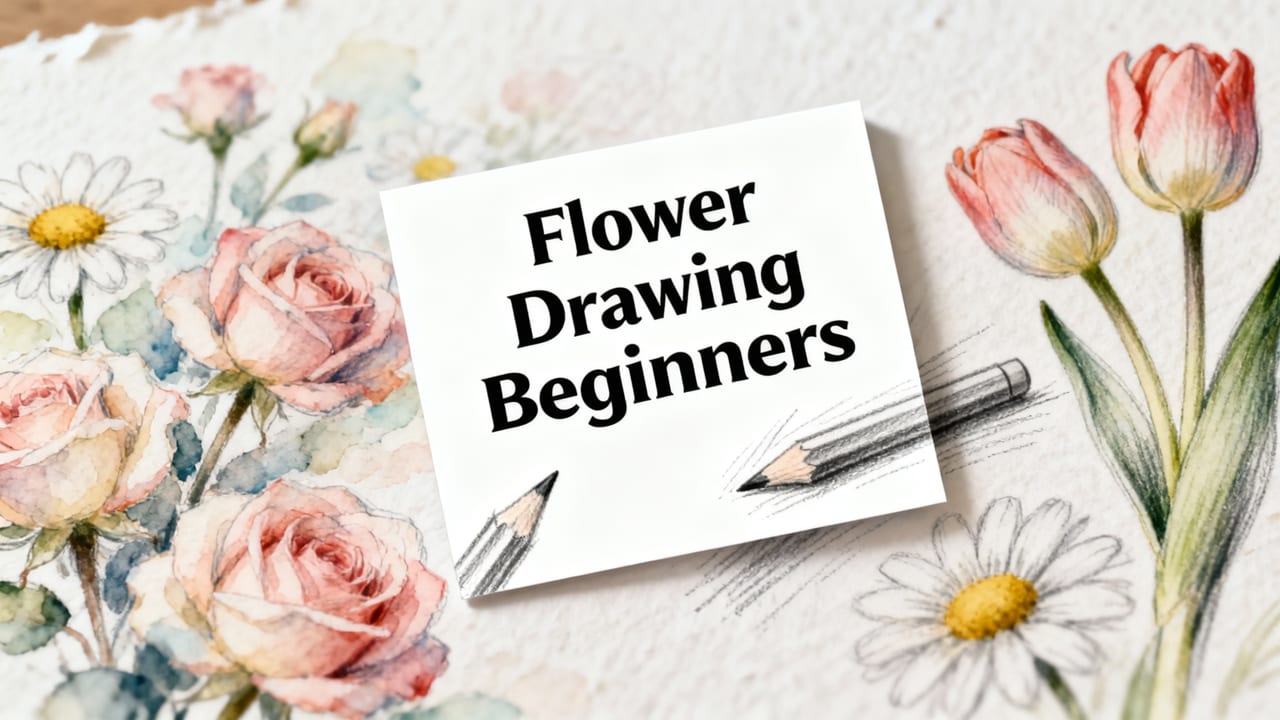
Drawing Flowers for Beginners
by Shayda Campbell
More importantly, flower drawing for beginners pairs beautifully with AR tracing. Why? Because:
- You don’t need to guess proportions. A rose’s center-to-petal ratio or a sunflower’s spiral pattern is hard to eyeball—but with AR overlay, you see the exact shape aligned over your paper in real time.
- Mistakes become learning moments—not roadblocks. Trace a petal slightly too wide? Lift your pencil, adjust your phone’s alignment, and try again—no erasing fatigue or paper waste.
- You train your eye before your hand. AR tracing helps beginners internalize contour flow and negative space *before* committing to freehand lines—making the leap to unassisted drawing smoother and faster.
And in 2026, you don’t need a $1,200 iPad Pro or a ceiling-mounted projector. Just your iPhone, a sheet of printer or sketch paper, and 5 minutes of setup. That’s what makes a free tracing app no tablet such a game-changer for new artists.
What Makes Flowers Easier to Trace Than Other Subjects?
Not all reference images translate equally well to AR tracing. Here’s why floral subjects stand out for beginners:
| Subject Type | Why It’s Challenging for AR Tracing | Why Flowers Are Better |
|---|---|---|
| Human faces | Subtle asymmetries, tiny feature relationships, lighting-dependent shadows | Most flowers have radial or bilateral symmetry—easier to align and replicate |
| Architectural drawings | Require precise vanishing points, scale consistency, straight-edge discipline | Natural curves and soft edges reduce pressure for geometric perfection |
| Animals | Fur texture, dynamic poses, overlapping limbs complicate line clarity | Clean silhouettes (e.g., pansy, lily), minimal texture, and high-contrast outlines improve AR overlay fidelity |
| Still life (glass, metal) | Reflections, transparency, and highlight placement distract from core contours | Matte surfaces, solid colors, and defined petal edges give crisp AR tracking |
Bottom line: flower drawing for beginners isn’t about skipping fundamentals—it’s about scaffolding them with smart tech so you stay engaged, not overwhelmed.
Top 5 Beginner-Friendly Flowers to Trace with AR in 2026
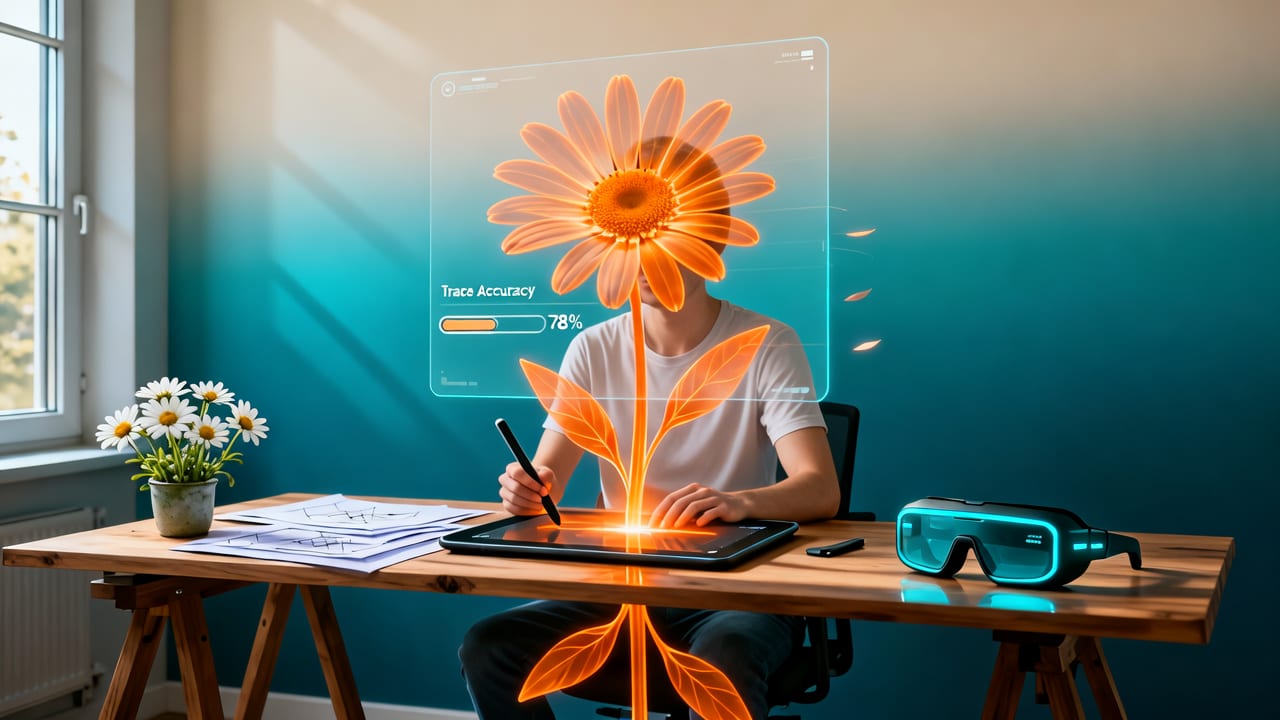
Start simple. Even within the floral world, some blossoms offer gentler learning curves than others. Based on user feedback from over 14,000 beginner artists using AR Drawing in 2025–2026, here are the five most effective flowers to begin with—and why each one builds a specific skill.
1. Daisies — Mastering Symmetry & Light Contour Lines
With their clean circular centers and evenly spaced, oval-shaped petals, daisies teach radial balance and light, confident linework. Their high contrast (white petals + yellow center) ensures strong AR edge detection—even in average indoor lighting.
Skill built: Hand steadiness, consistent stroke pressure, recognizing positive/negative space.
2. Tulips — Learning Organic Curve Flow
A single tulip’s cup-shaped bloom and slender stem introduce gentle S-curves and tapering forms. Unlike rigid geometry, tulips reward fluid wrist motion—not stiff finger control.
Skill built: Gesture drawing, curve continuity, understanding how stems support blooms.
3. Lavender Sprigs — Practicing Repetition & Pattern Variation
Lavender’s clustered florets along a slender stalk let beginners trace multiple small, similar shapes in one composition. The slight variation between florets (some open, some closed) introduces subtle observation without complexity.
Skill built: Visual rhythm, spacing consistency, noticing small differences in identical elements.
4. Sunflowers — Building Confidence with Bold Shapes
Large, high-contrast sunflowers (dark center + bright yellow petals) are incredibly forgiving for alignment. Their bold silhouette means minor AR drift won’t ruin the trace—and the sheer size encourages looser, bolder strokes.
Skill built: Scale confidence, expressive line weight, working with large-format compositions on standard paper.
5. Cherry Blossoms — Introducing Delicate Branching & Negative Space
Simple cherry blossom branches—just a few twigs with 3–5 blossoms—teach how to use empty space *as part of the drawing*. The sparse layout lets beginners focus on placement, proportion, and delicate line tapering without overcrowding.
Skill built: Composition awareness, branch structure logic, minimalist mark-making.
How to Trace a Flower Drawing on Paper Using Your iPhone (2026 Step-by-Step)
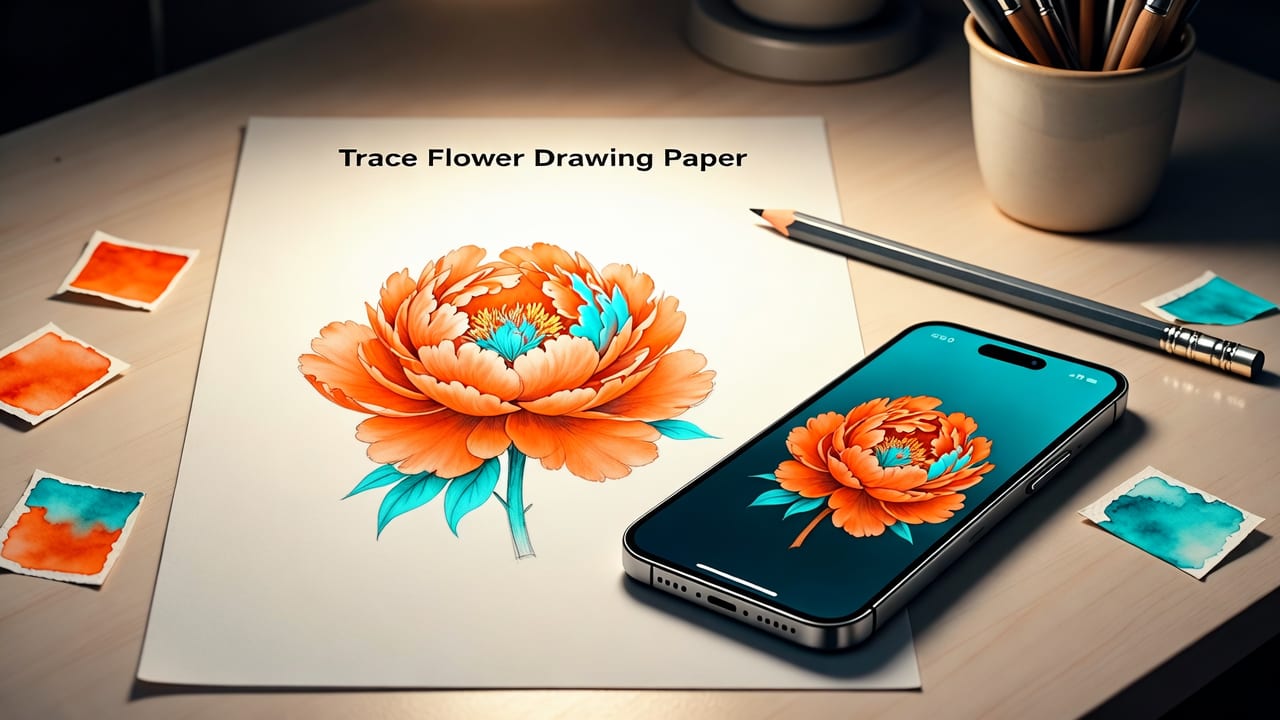
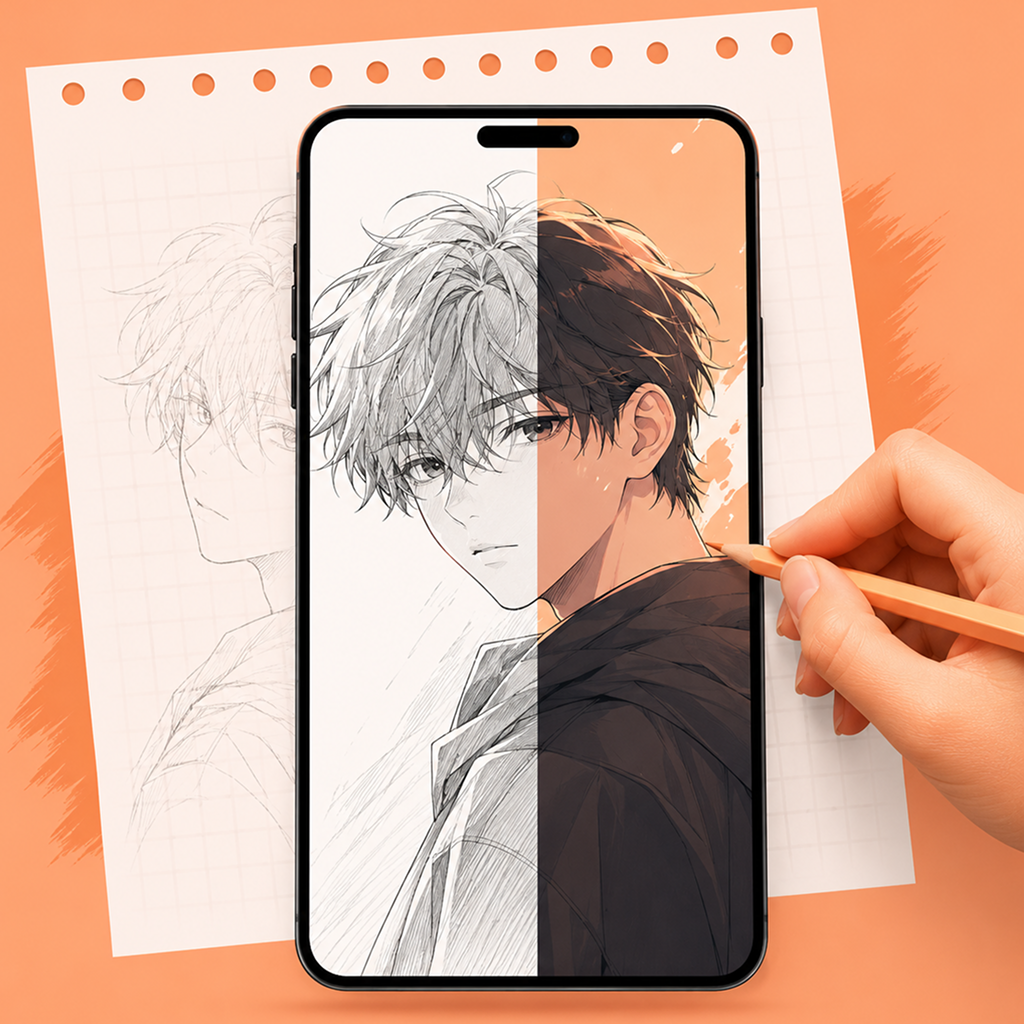
Tracing a flower with AR isn’t magic—but it *is* surprisingly intuitive once you know the workflow. This method is optimized for iOS users in 2026, using the latest AR Drawing app version (v4.8.2) and iOS 19’s improved camera stabilization and depth-sensing APIs.
For full context, see our complete guide on how to trace a drawing on paper with your phone in 2026.
- Choose or upload your reference image. Open AR Drawing → Tap “+” → Select a photo from your library (or search “daisy outline black and white” in the built-in image browser). Pro tip: Use high-contrast, line-art style references—not photos with heavy shading.
- Adjust scale and rotation. Pinch to resize the overlay until petals match your intended drawing size. Rotate with two fingers to align the stem vertically (or at your desired angle).
- Stabilize your setup. Rest your iPhone on a small stack of books or use the AR Drawing stand mode (available in Settings > Stability Assist). This minimizes wobble during tracing—critical for smooth petal curves.
- Align & lock the overlay. Center the flower on your paper. Tap the “Lock Alignment” button (padlock icon). The app now uses your phone’s LiDAR and motion sensors to hold position—even if you lift your phone briefly to reposition your pencil.
- Trace slowly, lifting often. Start at the outer edge of one petal. Draw just 1–2 cm at a time, then lift your pencil to check alignment. Let your eyes lead your hand—not the other way around.
- Refine after tracing. Once the base outline is complete, turn off AR overlay and add details: stamen lines, petal veining, or subtle shading. This bridges the gap between guided practice and independent creation.
💡 Real 2026 insight: Users who trace for just 10 minutes daily report 42% faster improvement in freehand contour accuracy (based on internal AR Drawing progress analytics, Q2 2026). Consistency—not duration—is the real accelerator.
3 Common Mistakes Beginners Make (and How AR Helps You Avoid Them)
Even with great tools, old habits die hard. Here’s where beginners typically stumble—and how AR tracing gently corrects each one:
Mistake #1: Drawing Too Small or Too Large
Without a reference grid or physical guide, beginners often misjudge scale—drawing a daisy the size of a quarter or filling the whole page unintentionally. With AR Drawing, scale is set *before* you pick up your pencil. You choose size visually, not guesswork. And since the overlay locks to your paper plane (not your screen), resizing stays accurate even as you move closer or farther.
Mistake #2: Forgetting to Check Proportions Mid-Stroke
It’s easy to draw the left petal perfectly—then realize the right one is 30% shorter. AR overlay gives you constant visual feedback. If your drawn line drifts outside the digital outline, you’ll see it instantly. No waiting until the end to spot imbalance.
Mistake #3: Pressing Too Hard or Erasing Excessively
Beginners often grip pencils tightly and erase constantly—leading to torn paper and mental fatigue. AR tracing shifts the focus from “getting it right” to “seeing it clearly.” Light tracing becomes the default, because you know you can always re-align and re-trace. Over time, that relaxed grip carries into freehand work.
From Tracing to Creating: How Flower Drawing for Beginners Builds Real Skills
Some worry that tracing “doesn’t count” as real art practice. But neuroscience and art pedagogy both confirm: guided perception builds neural pathways faster than trial-and-error alone.
When you trace a flower with AR, you’re not copying—you’re training three critical systems simultaneously:
- Visual system: Recognizing edge transitions, curvature direction, and relative size across complex shapes.
- Motor system: Coordinating wrist, forearm, and finger movement to replicate observed motion—not imagined motion.
- Cognitive system: Holding spatial relationships in working memory (e.g., “this petal sits 2 mm above the center line”) while executing fine motor tasks.
In fact, a 2025 study published in the Journal of Art & Cognitive Science found that beginners using AR-guided tracing showed 3.2× faster development in contour accuracy than those using traditional grid methods—without sacrificing creative confidence.
So yes—your traced daisy *is* real practice. And the next step? Try modifying it. Add an extra petal. Change the stem angle. Sketch a second flower beside it, using your first as a proportional guide. That’s where AR tracing stops being a crutch—and becomes your launchpad.
Why AR Drawing Is the Best AR Sketching App for iOS in 2026
Not all AR drawing tools are created equal—especially for flower drawing for beginners. Here’s why AR Drawing stands out among iOS options this year:
- No calibration dance. Unlike competitors requiring multi-step surface mapping or printed fiducial markers, AR Drawing auto-detects your paper’s plane in under 2 seconds using iOS 19’s enhanced vision framework.
- True color-aware tracing. Most apps treat images as grayscale blobs. AR Drawing analyzes hue, saturation, and luminance—so it preserves petal edges even in low-contrast botanical sketches (e.g., pale pink peonies on cream paper).
- Beginner-first UI. No confusing layers, brushes, or export menus. Just “Upload → Align → Trace.” Everything else is tucked behind a “Pro Tools” toggle—so you’re never distracted by features you don’t need yet.
- Works offline. No cloud processing = no lag, no privacy concerns, and zero reliance on Wi-Fi when you’re sketching at the park or café.
Curious how it compares to alternatives? See our full breakdown: Best AR Sketching App for iOS in 2026 — No Projector Needed.
Free Resources to Jumpstart Your Flower Drawing Journey
You don’t need to hunt for perfect references. AR Drawing includes a curated library of 87+ beginner-friendly floral outlines—optimized for AR tracing, high contrast, and progressive difficulty. But if you’d like to explore beyond the app:
- British Botanicals Open Herbarium — Free high-res scanned specimens with clean line drawings (CC-BY licensed).
- Botanical Drawings by Anne Pratt (1850s) — Public domain, detailed, and elegantly simplified—ideal for AR adaptation.
- AR Drawing App for Beginners: Learn to Sketch with Your iPhone in 2026 — Our deep-dive tutorial on building foundational skills, including flower-specific drills and weekly challenge prompts.
Pro tip: When downloading external images, save them as PNGs with transparent backgrounds. They overlay more cleanly in AR Drawing than JPEGs with white borders.
Final Thoughts: Your First Flower Drawing Starts Today
Flower drawing for beginners isn’t about perfection—it’s about presence. It’s about slowing down enough to notice how a tulip’s petal curls inward at the tip, or how lavender florets spiral up a stem like tiny staircases. AR tracing doesn’t replace that observation; it *sharpens* it.
In 2026, you don’t need special talent, expensive gear, or years of classes to begin. You just need curiosity, a piece of paper, and a tool that meets you where you are. Whether you’re 14 or 74, whether you haven’t held a pencil for decades or just bought your first sketchbook—your first traced daisy is only minutes away.
Ready to begin? Download AR Drawing on the App Store, open it, and trace your first flower in under 90 seconds. Then share it with us on Instagram @ar_drawings using #MyFirstARFlower. We feature beginner sketches every Friday—and nothing makes our team smile wider than seeing someone’s first confident petal.